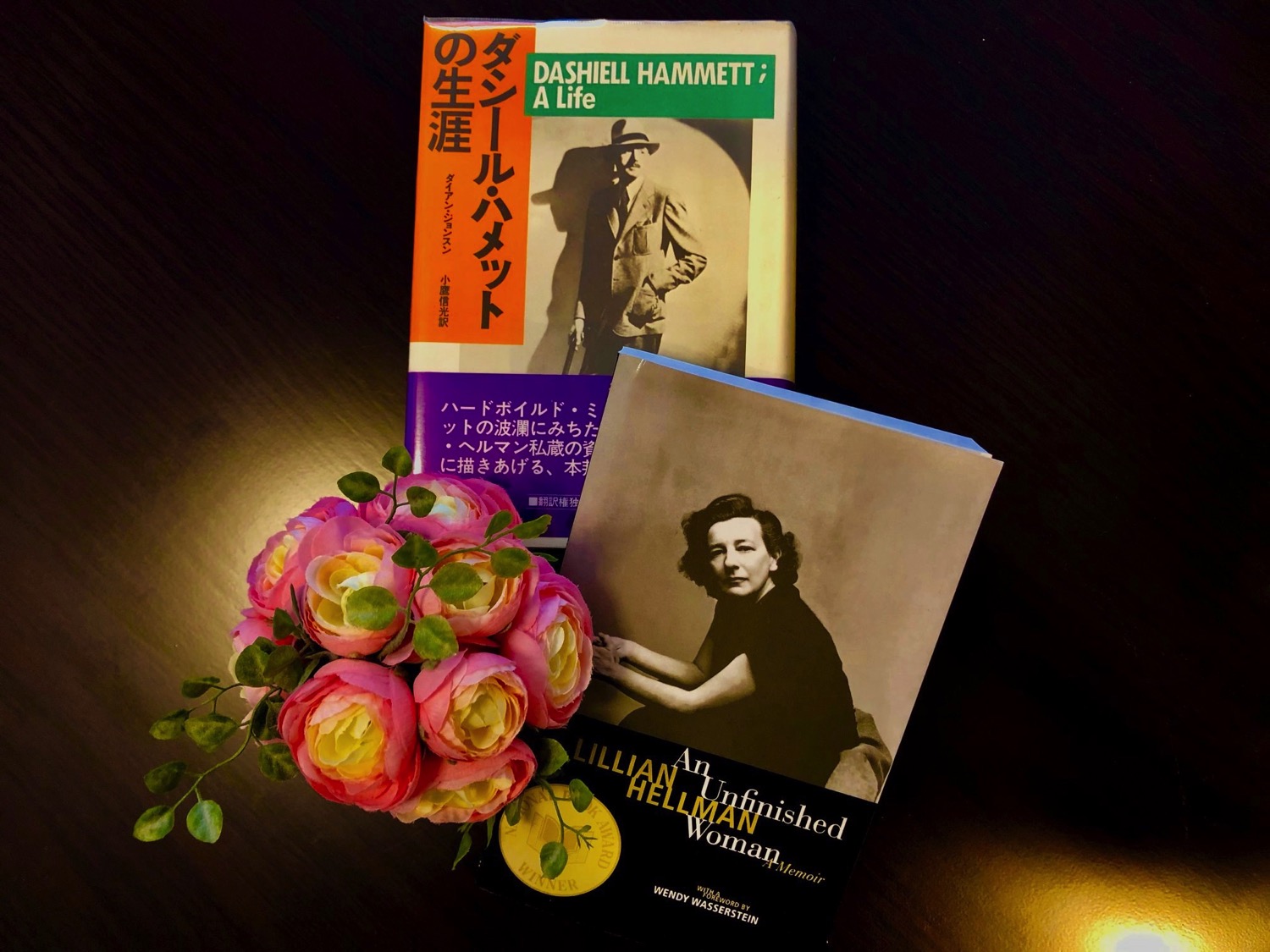
Tuesday, November 22, 2022

Lillian Hellman's Work

Plays

The Children's Hour (1934)

Days to Come (1936)

The Little Foxes (1939)

Watch on the Rhine (1941)

The Searching Wind (1944)

Another Part of the Forest (1947)

Montserrat (An adaptation, 1950)

The Autumn Garden (1951)

The Lark (An adaptation, 1956)

Candide (An operetta, 1957)

Toys in the Attic (1960)

My Mother, My Father and Me (An adaptation, 1963)

The Collected Plays (1972)

Memoirs

An Unfinished Woman (1969)

Pentimento (1973)

Scoundrel Time (1976)

Three (The collected memoirs, with new commentaries by the author, 1979)

Maybe (1980)

Eating Together: Recollections and Recipes (1984)

Editor of

The Selected Letters of Anton Chekhov (1955)

The Big Knockover: Selected Stories and Short Novels of Dashiell Hammett (1966)


Friday, July 16, 2021

Watch on the Rhine (1941)

 Watch on the Rhine” is a wartime drama, published and produced in 1941. It received the New York Drama Critics' Circle Award for the best American play in 1941.


A wealthy widow Fanny Farrelly is preparing for the arrival of her daughter Sara, her German husband Kurt Müller, and their three children Joshua, Babette and Bodo. Sara has lived in Europe with Kurt for nearly 20 years, without meeting her mother and brother.


Farrelly’s houseguest, Teck de Brancovis, is suspicious of Kurt and trying to figure out what he did in Europe. 

SARA: ...I just don't like polite political conversations anymore.  

TECK: All of us, in Europe, had too many of them. 

SARA: Yes. Too much talk. By this time all of us must know where we are and what we have to do. It's an indulgence to sit in a room and discuss your beliefs as if they were a juicy piece of gossip. 

- from Act Two

Kurt confesses he is an outlaw and work with many others in an illegal organization. Teck blackmails Fanny into paying large money to save Kurt.


KURT: ……All Fascists are not of one mind, one stripe. There are those who give the orders, those who carry out the orders, those who watch the orders being carried out. Then there are those who are half in, half hoping to come in. They are made to do the dishes and clean the boots. Frequently they come in high places and wish now only to survive.......For those last, we may well some day have a pity. They are lost men, their spoils are small, their day is gone. - from Act Three

Kurt expresses his profound love for his children with the following phrase before his departure.

KURT: ……Do you remember when we read “Les Misérables”? He stole bread. The world is out of shape we said, when there are hungry men. And until it gets in shape, men will steal and lie and - kill. But for whatever reason it is done, and whoever does it - you understand me - it is all bad. I want you to remember that. Whoever does it, it is bad. But you will live to see the day when it will not have to be. All over the world, in every place and every town, there are men who are going to make sure it will not have to be. They want what I want: a childhood for every child. For my children, and I for theirs. Think of that. It will make you happy. In every town and every village and every mud hut in the world, there is always a man who loves children and who will fight to make a good world for them. - from Act Three

Monday, February 1, 2021

Days to Come (1936)


“Days to Come” was first produced at the Vanderbilt Theatre, New York City, on December 15, 1936. 


In the middle of the Great Depression, the workers are striking against the factory owner Andrew Rodman in small Ohio town. His wife Julie told him he should set that right but he rejected. 

Julie: ……We haven’t talked about it much. I knew you didn’t want to. But the strike, these people here-it’s wrong for you. I know it’s so wrong for you. Settle it now. It doesn’t make any difference who wins-  

Andrew: (sharply) I don’t care who wins. If it were that simple, it would be fine. But it isn’t that simple. I can’t fit the pieces together…….I’ve only loved two things in my whole life: you and this town…….This was my home, these were my people, I didn’t want much else. But that’s been changed, I don’t know how. And I don’t know where I stand any more.” - from Act One

Leo Whalen, the labor organizer was sent to teach the strikers about non-violent methods to achieve victory in their labor struggles. However, before Andrew can understand what to do, the town was engulfed by violences and disasters. 


Labor strikes as a background, there are many other subjects in "Days to Come." Julie Rodman is always trying to find out about herself. She visited Leo Whalen at night, wanting him to show/teach her the way and go away with her. Andrew's best friend Henry Ellicott, a investor of the factory business, seems to love Julie. 


Ellicott: "And that's where I've got to quit." There isn't a man living who doesn't know about the woman who allows herself anything, but who invents the one rule that will keep her this side of what she thinks is respectable. She'll lie, but not on Thursday. She'll sleep with you, but not immediately after lunch. Usually, it's funny. In your case, for me, it's not so funny. (Angrily) What the hell did you expect me to mean to you?


Julie: (puts her hand on his arm) What did I expect you to mean to me? I don't know. I haven't any excuse, really. I've hoped for a very long time that everybody or anybody would mean something. (Smiles) Things start as hopes and end up as habits. ......"- from Act One


Rodman family lived quiet and polite in this small town with the people who know everything about each other and share secrets. "Polite and blind" they tried to live. In the end, Rodman family started to talk the truth hidden in their mind for a long time.

Julie: ...Darling, I told you the truth. I wasn't in love with you when we were married. I am not in love with you now. But I love you. Not the way I want to. But another way. More than anybody I've ever known.


Andrew: ...I know what you mean. You have done nothing to me.


Cora: No? That's a strange way of looking at it. Done nothing to you. She's broken you, that's what she's done. She's why you owe money- to Henry and to everybody else, She's why-


Ellicott: (violently) Is that your business, too?


Cora: No, thank you. It's not my money he's lost. But you needn't think I didn't know. I knew where it was going. The year her family lost their money and how her mother had to have the best doctors and how her brother had to go to Paris to study, and how she always had to have trips and clothes, and a year in Europe to make her happy. Thousands and thousands he had to borrow for it-


Julie: (suddenly, her voice hysterical) I didn't know that. I swear I didn't. We always had so much. Why didn't you tell me?


Andrew: It wasn't your business. It isn't now. I wanted it that way. I suppose, underneath, I always knew. I wanted to keep you. That was my way of trying.You had nothing to do with it. Nothing at all. 

“It’s the family I’m interested in principally; the strike and social manifestations are just backgrounds. It’s a story of innocent people on both sides who are drawn into conflict and events far beyond their comprehension. It’s the saga of a man who started something he cannot stop…” 

-from “An Adult’s Hour is Miss Hellman’s Next Effort” by Lucius Beebe/1936, “Conversations with Lillian Hellman” edited by Jackson R. Bryer

“Days to Come” was a commercial failure, closed after a brief run of seven performances. Lillian described in “Pentimento” that her guilt for the failure lasted for many years and she needed two years before writing another play “The Little Foxes”. However, it still deserves to watch and read.

Saturday, September 12, 2020

The Autumn Garden (1951)


"The Autumn Garden" opened on March 7th 1951 in Broadway, and ran for 102 performances. Lillian and Dashiell Hammett believe this is her best play.

Middle-aged people tend to think what their lives were, is, and will be in the winter of their lives. Such ordinary people are main characters of “The Autumn Garden”. Unlike Lillian’s another plays, no villains no heroes. Neither political nor sarcastic.

A group of middle-aged friends, mostly in their 40’s and 50’s, had a yearly gathering at a summer guest house on the Gulf of Mexico, a hundred miles from New Orleans, in 1949. The guest house’s owner Constance Tuckerman hosts her friends and relatives who face disappointments and regrets to their empty lives, and struggle to change but still be stuck.

Nicholas Denery and his wife Nina Denery. Nick had dates with Constance but ran away from her to become an artist in Paris. Constance romanticizes her memory with Nick, keeping her portrait in her youth drawn by Nick. She gets nervous to meet him again.

Carrie Ellis, her son Frederick Ellis and her witty mother in law Mrs. Mary Ellis in her seventieth. Constance’s French niece Sophie is prepared to marry Frederick though they are not in love. Sophie and Frederick are only young couple among them.

Here's conversation between Sophie and Ned Crossman.

CROSSMAN: ……listen to me, Sophie. I say turn yourself around, girl, and go home. Beat it quick.

SOPHIE: You take many words to say simple things. All of you. And you make the simple things - like going to sleep - so hard, and the hard things - like staying awake - so easy............ Therefore I will do the best I can. And I will not cry about it and I will not speak of it again.

CROSSMAN: The best you can?

SOPHIE: I think so. Maybe you’ve never tried to do that, Mr. Ned. Maybe none of you have tried.

CROSSMAN: Sophie, lonely people talking to each other can make each other lonelier. They should be careful because maybe lonely people are the only people who can't afford to cry. I’m sorry.” - Quote from Act One
Nick has a habit to flirt with women by drawing portraits. Mrs. Ellis advises him to "try something intellectual for a change" but he does not. Moreover, he is criticized “a gifted amateur” by his wife Nina. He is drunken too much and falls asleep on Sophie’s bed in the living room. It is a big nuisance, a rumor goes around a small village. Everyone is in a panic, except Sophie. She demands five thousand dollars to Nina as “the most degrading experience from which no young girl easily recovers”.
NINA: You are serious? Just for a word, a way of calling something, you would hurt my husband and me?

SOPHIE: For me it is more than a way of calling something.

NINA: You’re a tough little girl.

SOPHIE: Don’t you think people often say other people are tough when they do not know how to cheat them?” - Quotes from Act Three

Sophie did her best to go home…

One more couple trying to change. A retired General Ben Griggs and his ex-pretty soft-looking wife Rose. Ben wants to divorce her and Rose wants to hold on to him. Finally Rose said honestly she is ill and wants him to stay with her this year.

ROSE: ...please stay with me this year, just this year. I will give you a divorce at the end of the year. I will swear a solemn oath - believe me I’m telling the truth now - I will give you a divorce at the end of the year without another word. I’ll go and do it without any fuss, any talk. But please help me now. I’m so scared. Help me, please. One year’s a lot to ask, I know, but -

BEN: Of course. Of course. Now don’t let’s speak of it again and we’ll do what has to be done.”
Ben made a decision to stay with her though he doesn’t love her any more.

The most significant and touching speech by Ben Griggs is:

“So at any given moment, you're only the sum of your life up to then. There are no big moments you can reach unless you've a smaller pile of moments to stand on. That big hour of decision, the turning point in your life, the someday you've counted on when you'd suddenly wipe out your past mistakes, do the work you'd never done, think the way you'd never thought, have what you'd never had - it doesn't come suddenly. You've trained yourself for it while you waited - or you've let it all run past you and frittered yourself away. I've frittered myself away..." 

Nick lied to Constance that Ned still loves her and wants to marry her. She tells Ned to marry her but he explains he is not in love with her now.

CROSSMAN: I’ve kept myself busy looking into other people's hearts so I wouldn't have to look into my own. If I made you think I was still in love, I'm sorry. Sorry I fooled you and sorry I fooled myself. And I've never liked liars-least of all those who lie to themselves.

CONSTANCE: Never mind. Most of us lie to ourselves, darling, most of us."

These long-term friends finally said things that had remained unsaid for many decades. 

When we want to start a new life all over again, we'd go back to where we started and start from there. This may be one of messages from her. 

Tuesday, August 18, 2020

Toys in the Attic (1960)

 “Toys in the Attic” is Lillian’s last play. It’s a family-oriented story describing destructive part of sibling love.

Toys in the Attic by Lillian Hellman

Carrie & Anna Berniers, two unmarried sisters, live in New Orleans where they wait for visits from their younger brother Julian. After some absence, Julian returns home from Chicago with a large sum of mysterious cash and his “infant bride” Lily Prine. Julian tells his sisters that, though he lost the factory in Chicago, he did manage to save money to buy expensive gifts for his sisters, pay off the house and send them on a trip to Europe that they've long wished to do.
Carrie and Anna took care of him like a mother, desiring his success. However, once he succeeds, two sisters and even his wife seem not to be pleased with it and still skeptical about his success.

Julian said to his sisters in Act One, 

“Big, successful Julian, the way you wanted me. The man who was never good at anything except living on his sisters, and losing his wife’s money. I never minded failure much, you minded.”
On the other hand, Lily’s mother Albertine Prine reacts differently to his success. She unwrapped the package and arranged a comb on her head, saying “how very nice of you to bring it to me.”

Julian was puzzled by her attitude, totally different from his sisters and wife, and said;

JULIAN: …… Well, they’re sort of upset and they don’t think I know it. I should have had sense enough to know that when you’ve been poor and wanted things you couldn’t have, your stomach gets small and you can’t eat much right away. I brought too much, and everything too grand, and well - Guess they got a little sick. They’re so happy that it comes out unhappy.You know how it is?
ALBERTINE: I don’t think so.
JULIAN: It’s a crazy old world. For years, they tell me about what’s going to be, what I’m going to do, you know, get rich and big time. The more I fail, the louder they cheer me with what we’re all going to have, want. And so all my life, I dream about coming up those steps carrying everything, and I make up what they will say, and what I will say - Well, when it came, I guess it was hard to believe, maybe even frightened them, I never thought of that, and I just bought anything if it cost a lot, and made Carrie sick on caviar, and everybody acted scared, and like they were going to cry. Lily did cry - Natural enough. You know?
ALBERTINE: No, I don’t know. You’ve had good fortune and brought it home. There’s something sad in not liking what you want when you get it. And something strange, maybe even mean. Nobody should have cried about your good fortune, nobody should have been anything but happy. -Quotes from Act Two, Page 47 to 48
Albertine from Toys in the Attic

 Carrie and Anna thought he’s come home broke, like a never grow up kid. They are ready to give him all they had, and tell nice lies about how the next time. However, they are not ready to have successful brother, then get sick. Anna tries to take a chance of changing her life by going to Europe. But Carrie wanted Julian to need her again and live together with three of them, missing the past before his marriage. In the end, Carrie took advantage of Lily’s innocence to let Julian fail again…

Albertine gave a good-bye present to her daughter Lily.


“the pure and the innocent sometimes bring harm to themselves and those they love and, when they do, for some reason that I do not know, the injury is very great.” - Quote from Act Three, Page 76

Carrie and Anna are loosely based on Lillian’s paternal aunts Jenny and Hannah. Lillian described how she thought about them in Page 76 and 77 of “MAYBE”.

Maybe by Lillian Hellman

“they had lived doing the uncomplaining work of women brought up by middle-class intellectual parents who grew more educated as they grew poorer; going out to find any kind of work in a social class where that was a kind of disgrace; certainly pained by it once upon a time, but not by the time I knew them; proud, cranky, married to each other; frightened of life with brave faces; never owning anything that didn’t come from sales or cheap auctions; cooking, scrubbing, never admitting a pain or an ache, so totally different from my mother’s rich family - a comedy villain crew.
They were fine women for a little girl to be around although, of course, I didn’t think of them that way when I was a child. But I did know from the time I was two or three years old that I enjoyed them. And, later on, I knew that the things I learned from them would be good and valuable for me all my life. Not that they were teachers, or ever tried to be teachers, but I guess that’s what they were for me.”

Tuesday, March 3, 2020

The Children's Hour (1934)

Lillian Hellman wrote "The Children's Hour" with help from Dashiell Hammett, six years after they had first met. He suggested to her to write the first play within an established framework, referring to "Bad Companions" by Willian Roughead, a lawsuit accusing teachers of lesbianism in Edinburgh in the 19th century.

It was a smash hit, first produced at Maxine Elliot's Theatre in New York City on November 20th 1934, and ran for 691 performances in the United States, and performed in London and Paris afterwards. This play is going to be a tragic ending on a school stage, when one student tells a lie that two female teachers are lesbians. These two were supposed to be best friends, but one of them noticed there might be a lesbian element in her, and eventually she committed suicide. At that time, it was shocking and sensational theme in the United States where it was considered as a taboo. "The Children's Hour" made Lillian a celebrity at the age of 29.

Two young women Karen Wright and Martha Dobie worked eight years to save money to buy a farm, to start a school for girls. However, one single lie by a malicious girl Mary Tilford destroyed their whole life...

Here's a quote from "The Children's Hour".
KAREN: I don't want to have anything to do with your mess, do you hear me? It makes me feel dirty and sick to be forced to say this, but here it is: there isn't a single word of truth in anything you've said. We're standing here defending ourselves - and against what? Against a lie. A great, awful lie.
MRS. TILFORD: I'm sorry that I can't believe that.
KAREN: Damn you!
CARDIN: But you can believe this: they've worked eight long years to save enough money to buy that farm, to start that school. They did without everything that young people ought to have. You wouldn't know about that. That school meant things to them: self-respect, and bread and butter, and honest work. Do you know what it is to try so hard for anything? Well, now it's gone...
These Three of good - Karen, Martha and Joe - struggled to combat the evil threatened to destroy their whole life, by insisting on innocence to Mrs. Tilford and the public but all failed.

And then self-doubts begin to appear among these three. Joe questioned Karen’s innocence and Martha started to admit her guilty feeling to Karen.

Here's another quote from The Children's Hour.
MARTHA: I've been telling myself that since the night we heard the child says it; I've been praying I could convince myself of it. I can't, I can't any longer. It's there. I don't know how, I don't know why. But I did love you. I do love you. I resented your marriage; maybe because I wanted you...
KAREN: It's a lie. You're telling yourself a lie. We never thought of each other that way.
MARTHA: No, of course you didn't. But who says I didn't? I never felt that way about anybody but you. I've never loved a man... I never knew why before. Maybe it's that.
KAREN: You are tired and sick.
MARTHA: It's funny; it's all mixed up. There's something in you, and you don't know anything about it because you don't know it's there. I couldn't call it by name before, but I know now. It's there. It's been there ever since I first knew you. I don't know. It all seems to come back to me. I've ruined your life and I've ruined my own... Oh, I feel so damn sick and dirty I can't stand it anymore!"
KAREN: All this isn't true. You've never said it; we'll forget it by tomorrow.
MARTHA: Tomorrow? That's a funny word. Karen, we would have had to invent a new language, as children do, without words like tomorrow.
In the interview by Lucius Beebe on December 13th 1936, Lillian Hellman said about the theme of the play;
"It's a story of innocent people on both sides who are drawn into conflict and events far beyond their comprehension. It's the saga of a man who started something he cannot stop, a parallel among adults to what I did with children in "The Children's Hour."
- from "Conversations with Lillian Hellman" edited by Jackson R. Bryer
In the interview by Harry Gilroy on Dec. 14th 1952 from the New York Times, she said;
"Here's another observation I make about the play today as I work over it. On the stage a person is twice as villainous as in a novel. When I read that story I thought of the child as neurotic, sly, but not the utterly malignant creature which playgoers see in her. I never see characters as monstrously as the audiences do ......this is really not a play about lesbianism, but about a lie. The bigger the lie the better, as always."
- from "Conversations with Lillian Hellman" edited by Jackson R. Bryer

Monday, March 2, 2020

Another Part of the Forest (1947)

"Another Part of the Forest" opened on Nov. 20th 1946, seven years after "The Little Foxes".
Regina's mother Lavinia married Marcus without love from the beginning, so she wishes to escape. Grown in such circumstances, their children Regina, Ben and Oscar have never known love in the family.
Regina has a plan to make her dreams of marriage with Bagtry, but her older brother Ben has his own plan how to get the money he needs to invest for Hubbard fortune, once he knows that Bagtry's cousin Birdie needs a loan in order to save her family's estate. These two siblings find themselves at cross-purposes for their plans.
Lavinia has a secret that her husband wants to be kept forever. She is a witness to his sin. He has kept watching her not to reveal it but......

 "LAVINIA: You don't need half this proof. That's the trouble with your kind of thinking, Benjamin. My, I could just walk down the street, tell the story to the first people I met. They'd believe me, and they'd believe Coralee. We're religious women and everybody knows it. And then they'd want to believe us, nothing would give them so much pleasure as, as, as, well, calling on your Papa. I think people always believe what they want to believe, don't you?"

Lillian described in "Pentimento" she had always planned "The Little Foxes" as a trilogy, knowing that she had jumped into the middle of the life of the Hubbards and would want to go forward in time. She had meant the first play as a kind of satire and tried to do that in "Another Part of the Forest," but the critics thought straight stuff; what she thought was bite they thought sad, touching, or plotty and melodramatic. 

The Little Foxes (1939)

"The Little Foxes" opened on Feb 15 1939 at the National Theatre and ran for 410 performances. It's a chilling story of the financial and psychological conflicts within a wealthy Southern family Hubbard. Regina Hubbard Giddens and her brothers, Oscar and Ben, plan to get rich from a cotton mill. To fulfill their ambitions, they attempt to tap into (or steal) the wealth of Horace Giddens, Regina's sickly husband. And they have another plan to marry Regina's daughter Alexandra to Oscar's son Leo. 
BIRDIE: ......in twenty years you'll be like me. They'll do all the same things to you. You know what? In twenty-two years I haven't had a whole day of happiness. Oh, a little, like today with you all. But never a single, whole day. I say to myself, if only I had one more whole day, then-And that's the way you'll be. And you'll trail after them, just like me, hoping they won't be so mean that day or say something to make you feel so bad-only you'll be worse off because you haven't got my Mama to remember-

ALEXANDRA: I guess we were all trying to make a happy day. You know, we sit around and try to pretend nothing's happened. We try to pretend we are not here. We make believe we are just by ourselves, some place else, and it doesn't seem to work. Come now, Aunt Birdie, I'll walk you home. You and me.

ADDIE: (After a minute) Well, First time I ever heard Miss Birdie say a word. *Quotes from Act Three
PHOTO from "World Literature" published by Asahi Newspaper, (c) Martha Swope, Time Inc.

Regina did not help Horace to have a medicine when he had a heart attack, just watching him die.

REGINA: There are people who can never go back, who must finish what they start, I am one of those people.

Alexandra noticed what her mother did to her father. 

Alexandra: ...there were people who ate the earth and other people who stood around and watched them do it. ......I'm not going to stand around and watch you do it...I'll be fighting as hard as he'll be fighting some place where people don't just stand around and watch. 

The main part Lillian wanted to tell us may be the following speech by Ben. 

Ben: Well, I say to myself, what's the good? You and I aren't like Oscar. We're not sour people. I think that comes from a good digestion. Then, too, one loses today and wins tomorrow. I say to myself, years of planning and I get what I want. Then I don't get it. But I'm not discouraged. The century's turning, the world is open. Open for people like you and me. Ready for us, waiting for us. After all this is just the beginning. There are hundreds of Hubbards sitting in rooms like this throughout the country. All their names aren't Hubbard, but they are all Hubbards and they will own this country some day...

"The Little Foxes" was the most difficult play Lillian Hellman ever wrote, because it had a far connection to her maternal family. She described about it in the Introduction of "Three."

I had meant to half mock my own youthful high-class innocence in Alexandra, the young girl in the play; I had meant people to smile at, and to sympathize with, the sad, weak Birdie, certainly I had not meant them to cry; I had meant the audience to recognize some part of themselves in the money-dominated Hubbards; I had not meant people to think of them as villains to whom they had no connection. 

Sunday, March 1, 2020

1. Early Life of Lillian Hellman

Lillian Hellman was born as the only child of Julia Newhouse and Max Hellman on June 20th 1905 on Prytania Street in New Orleans. Her mother’s family was rich, upper-middle-class. Her father ran a shoe store but went bankruptcy in 1911, then became a traveling salesman. Lillian lived in New York with her mother's relatives and lived in New Orleans with her father’s sisters every six months.

She described her experiences in “An Unfinished Woman”(1969).

A Memoir by Lillian Hellman
"I was thus moved from school in New York to school in New Orleans without care for the season or the quality of the school. This constant need for adjustment in two very different worlds made formal education into a kind of frantic tennis game, sometimes played with children whose strokes had force and brilliance, sometimes with those who could played with those who could barely hold the racket. Possibly it is the reason I never did well in school or in college, and why I wanted to be left alone to read by myself. I had found, very early, that any other test found me bounding with ease and grace over one fence to fall on my face as I ran towards the next."
She continued this "frantic tennis game" life from the age of six until she attends college.
Her experiences, treated as the poor granddaughter in New York, made her into an angry child and caused her mixture of respect and hatred for money and people who have it. Her avaricious relatives later appeared in "The Little Foxes"(1939), a chilling story of the financial and psychological conflicts within a wealthy Southern family.
Peter Feibleman wrote about her mother's family oriented influence on her in “LILLY: Reminiscences of Lillian Hellman”:
“It was because of her mother’s family that she was attracted to the rich and hated them all her life. She never came to terms with growing up, and the outraged heart of childhood lasted through old age.”
In the early 1920s, she studied at New York University and Columbia University. Then she immediately got a job as a manuscript reader with Horace Liveright, a publisher in New York. She left the Liveright to marry Arthur Kober in 1925, who was a theatre press agent. In the first few years of marriage, she traveled to Paris and wandered around Europe. Then Kober was offered a job as a scenario writer for Paramount Pictures, and prepared for her job of reading manuscripts & writing reports at MGM.
About her life with Kober, she described in “An Unfinished Woman” (1969) as follows:
“I did not yet know about “inhuman cities” or roads built with no relief for the eye, or the effects of a hated house upon the spirit. I didn’t even understand about my marriage, or my life, and had no knowledge of the new twists I was braiding into the kinks I was already bound round with.”
Though she felt the work dull, it provided her the opportunity to meet a wider range of creative people.
“I was rash, overdaring, certain only that any adventure was worth having, and increasingly muddled by the Puritan conscience that made me pay for the adventures. I needed a teacher, a cool teacher, who would not be impressed or disturbed by a strange and difficult girl. I was to meet him, but not for another four or five years.”
It was in Hollywood that she had a fateful encounter with the hard-boiled ex-detective novelist Dashiell Hammett, beginning a close friendship with "a cool teacher" which lasted for thirty years.

2. "On and Off" relationship with Dashiell Hammett

When Lillian first met Dashiell Hammett in 1930, he almost reached the end of his writing career, publishing four novels "The Red Harvest" (1929), "The Dain Curse" (1929), "The Maltese Falcon"(1930) and "The Glass Key" (1931). Hammett greatly contributed to create "hard-boiled" genre. Sam Spade was his central character after 1929, becoming the symbol of the American private eye. 
They met for the first time at a restaurant in Hollywood and fell in love immediately. Lillian described her encounter with Hammett in "An Unfinished Woman"(1969). 
PHOTO from "World Literature" published by Asahi Newpaper, (c) Martha Swope, Time Inc.
"We met when I was twenty-four years old and he was thirty-six in a restaurant in Hollywood. The five-day drunk had left the wonderful face looking rumpled, and the very tall thin figure was tired and sagged. We talked of T. S. Eliot, although I no longer remember what we said, and then went and sat in his car and talked at each other and over each other until it was daylight. We were to meet again a few weeks later and, after that, on and sometimes off again for the rest of his life and thirty years of mine.”
Before long Lillian was divorced from Kober. Hammett was married to Josephine Dolan in 1921, divorced his wife in 1937. Though these two never married, they became inseparable and maintained "on and off" relationship for 30 years until Hammett's death in 1961.
With help from a "cool teacher" Hammett, Lillian wrote "The Children's Hour" (1934) and became the best-known and the only one female playwright in the world. 
Hammett wrote his final novel "The Thin Man" (1934). Lillian was a model of his resolute female character Nora Charles. She described how he was writing a long piece of work.
"Life changed: the drinking stopped, the parties were over. The locking-in time had come and nothing was allowed to disturb it until the book was finished. I had never seen anybody work that way: the care for every word, the pride in the neatness of the typed page itself, the refusal for ten days or two weeks to go out even for a walk for fear something would be lost. It was a good year for me and I learned from it and was, perhaps, frightened by a man who now did not need me." from "An Unfinished Woman"
After that, Hammett stood behind her to help in her writing more plays "Days to Come" (1936), "The Little Foxes"(1939), "Watch on the Rhine" (1941), "The Searching Wind" (1944), "Another Part of the Forest" (1947) and "The Autumn Garden" (1951). 
In April 1951 during the McCarthy era, Dashiell Hammett refused to disclose names and was sentenced to prison for 6 months for contempt of Congress by the House Un-American Activities Committee (HUAC). Lillian was called upon to testify before the HUAC in May 1952. When she was asked "Are you now or have you ever been a member of the Communist Party?", She answered NO. Then she wrote a letter to the HUAC that she would be willing to answer all questions about herself but no questions about anyone else. The last paragraph of the letter became a kind of slogan:
"To hurt innocent people whom I knew many years ago in order to save myself is, to me, inhuman and indecent and dishonorable. I cannot and will not cut my conscience to suit this year's fashions."
 Though she refused to reveal the names of any associates in the theater, she was not sent to jail but blacklisted for ten years. Her plays were banned from theaters and weren't produced much. Then she sold her farm "Hardscrabble" in Pleasantville, N.Y., and had worked as a sales person and an accounting department at Macy's under a different name, according to "LILLY: Reminiscences of Lillian Hellman".

During this period, Lillian wrote and directed "Montserrat" (1949), the first of several adaptations. "The Lark" (1955), a reworking of Jean Anouilh's drama L'alouette based on the trial of Joan of Arc, and "Candide" (1956), adapted from Voltaire's classic novel. Peter Feibleman said in his memoir about her that she didn't have the heart to write another play for a long time, and the luster for her fame as a playwright had dulled over and it never quite came back.

When Hammett came out of jail, she came back to New York to meet him.
"Jail had made a thin man thinner, a sick man sicker." - from "An Unfinished Woman" (1969)
 It was the first time she knew he would now always be sick.

"...he lived with me for the last four years of his life. Not all of that time was easy, indeed some of it was very bad, but it was an unspoken pleasure that having come together so many years before, ruined so much, and repaired a little, we had endured. Sometimes I would resent the understated or seldom stated side of us and, guessing death wasn't too far away, I would try for something to have afterwards.
One day I said, "We've done fine, haven't we?"
He said, "Fine's too big a word for me. Why don't we just say we've done better than most people?"" - from "An Unfinished Woman"
Hammett died of lung cancer on January 10, 1961. Their 30 years relationship came to the end. 

3. Cakewalk dance with Peter Feibleman

Lillian and Peter Feibleman first met in 1940 when Peter was 10 years old and Lillian was 35. Lillian had been invited to the party as a friend of Peter's mother.
LILLY: How old are you?
CUFF: Only ten.
LILLY: I don't know what you mean by "only." Ten's not so young.
CUFF: It's n-not?
LILLY: It's not.
- from Act One of "Cakewalk"
When Peter was invited to Lillian's house in Martha’s Vineyard in the early 1960s, he started to build a close friendship as depicted in the Cakewalk. Yes, these two strange amusing communal lives began here.

Lillian was a teacher for Peter as well as Hammett was for her. She encouraged him to write a new book by disclosing everything to overcome trauma in his childhood. Her advice helped him to come out of slump, and he published later "The Columbus Tree" about Spain.
At that time, Lillian had stopped writing a play, but one day she read the article in The Times;
A Memoir "Lilly: Reminiscences of Lillian Hellman" & Play "CAKEWALK" by Peter Feibleman
"The great American playwrights who are still active, Tennessee Williams, Arthur Miller, Edward Albee" - no mention of me. I'm not dead yet, but I'll have to prove it. I'd like to start the memoir in New Orleans.  from "Cakewalk"

She wrote "An Unfinished Woman" (1969), "Pentiment" (1973), "Scoundrel time" (1976) and "Maybe" (1980), and they were a great success.

These memoirs provoked much controversy by Diana Trilling, Muriel Gardiner, Norman Podhoretz and others. Especially Mary McCarthy was famously said of Lillian on the Dick Cavett television show in 1979, “Every word she writes is a lie, including ‘and’ and ‘the’.” Ironically, their attacks on her greatly contributed to remain Lillian as a legendary writer.
According to the article of Washington Post, Lillian won the first round of the suit when a New York state judge ruled that she was not a public figure, which allowed the suit to go forward, a judgment that McCarthy appealed. Lillian's death means that the lawsuit is over. Ephraim London, Lillian's attorney, said "It wasn't the money she cared about. In fact we offered early on to drop it if McCarthy would apologize. But she refused . . . We agreed that if we won the verdict, we would both get a car and a chauffeur."

Peter described her new form of memoirs in Page 148 of  "LILLY: Reminiscences of Lillian Hellman":
"Lillian was in the process of dramatizing her life. She brought to the business of memory the art of fiction and she was begining to forge for herself a new form. Because I was interested in what she was doing it never occurred to me at the time that people would take all the details of the story for literal truth, since it seemed so clear that she was fusing fact with fiction. Lillian wrote about that in the last of the four memoirs, MAYBE, whose title carries the meaning of the whole. Shortly after MAYBE was published and not long before she died, Lilly remarked to a friend that she'd discovered a new form for herself in writing, a form that was neither fiction nor memory but a combination of both, which is probably what most recollection is. "I've been overpraised for the books," she said, "I'll be attacked too hard to make up for it - but maybe one day they'll be read for what they are."
Despite almost losing sight with glaucoma and embedding pacemakers and relying on wheelchairs, she never gave up writing until her last moment.
"Lillian went to the Vineyard at the beginning of the summer and waited for me there. The galleys were held up an extra few days at the publisher's, too late to bring them for her birthday, and I called to tell her so.
"You can't be late," Lilly said.
I told her it was only a matter of days.
"You don't understand," she said, "I want to work, I want to work, I want to work...""
- from "LILLY: Reminiscences of Lillian Hellman" written by Peter Feibleman
Peter could pick up the galleys in time to catch an earlier flight but she died of cardiac arrest on June 30th 1984 before his arrival.
The nurse said "she took one of my hands and held it...so affectionate, you know - and then she began to squeeze my hand very hard - very, very hard - and she said: 'I think you and I are going to get along just fine,' Then she died."

Lillian was a writer until her last moment. I believe she did break "the worst case of writer's block."

Here's some part of graveside eulogy by John Hersey in "LILLY: Reminiscences of Lillian Hellman."
 "Her inmost fire, though, was not sensual. It was in the mind. It was a rage of the mind against the unfairness of death. In everything she wrote, and in her daily life, she fought against slander, greed, hypocrisy, cruelty and everything shabby and second-rate and dangerous in those in power. She was very, very angry at death - and not just at the end. Death became her enemy years ago, when Hammett died, and this enemy made her even more vibrant and alive.

What could calm this anger? Only the sea, and money, and love. Anyone who gave her the slightest flicker of love got in return a radiance of laughter and fun that was unbelievably enjoyable; this was the bright other face of the anger.

Dear Lillian, you are a finished woman, now. I mean "finished" in its better sense. You shone with a high finish of integrity, decency, uprightness. You have given us this anger to remember and to use in a bad world. We thank you, we honor you, and we all say good-bye to you now with a love that should calm that anger of yours forever."